
English & Literacy
Literacy
The understanding and use of language are fundamental to learning for all children. Therefore, literacy is an integral part of our curriculum and is embedded throughout the school day at The Vale of Evesham School. All children have the entitlement to develop their literacy skills. Our teaching embraces all aspects of language development, and we take a bespoke approach to ensure pupils engage in literacy lessons that are motivating, meaningful and complement their learning style.
To ensure our learners have opportunities to access all aspects of the English curriculum and for it to be effective, input is required from parents, speech and language therapists and advisory services that support learners with additional sensory requirements. Learners for whom English is a second language will develop their understanding of vocabulary through our total communication approach, and their mother-tongue will continue to be recognised and celebrated.
Intent
The English Curriculum at the Vale of Evesham School aims to:
- Embed the use of communication through a total communication approach so that pupils can communicate effectively with others in a range of social situations and the world around them
- Promote a love for books, stories, reading for pleasure and purpose
- Motivate pupils to engage with a range of literature
- Provide bespoke learning opportunities and approaches for pupils accessing the complex curriculum so that they can engage with people and their environment
- Appropriately challenge learners so that they grow in confidence and competency with all areas of literacy
- Expose pupils to an extensive range of age-appropriate literature and writing opportunities that match pupils’ cognitive abilities
- Equip pupils with skills to use literacy in the wider community and life beyond school
Subject Organisation
At the Vale of Evesham School, English will be delivered both as discrete subjects and through a cross-curricular approach. For all learners to have engaging and appropriate opportunities for progression, we have adopted a curriculum structure of three broad strands across the school; complex, semi-formal and formal. These strands of the curriculum are defined by the learning needs and therefore pupils may move from one strand to another during their school career. To ensure new literacy skills are built upon secure foundations across all three strands of the curriculum, long term plans and a whole school text map/ complex story map are used to inform planning for progression.
Teaching time allocated to literacy lessons varies according to the strand of the curriculum and year group shown in tables below.
Reading
At the Vale of Evesham School, we acknowledge that learning to read in its widest sense is central to the curriculum intent of the school. Progress in reading enables our pupils to access opportunities both in school and the wider community with independence and confidence. Reading provides pupils with rich communication opportunities and supports them in achieving their desired outcomes on leaving school. Our approach to reading:
- Acknowledges that stimulus (e.g., smell/sound/facial expressions) carries meaning
- Acknowledges that objects carry meaning
- Teaches that photographs and pictures represent objects, people and places and carry meaning
- Teaches that symbols can be used as labels and to access text as well as supporting communication
- Ensures that narrative can be accessed through sensory-based activities
- Emphasises systematic synthetic phonics is our favoured approach to teaching reading using the Read Write Inc. Phonics programme
- Teaches the reading of words, new vocabulary and comprehension
Intent
At the Vale of Evesham School, we intend for pupils to:
- Understand their immediate environment so they feel secure and ready to engage in learning
- Use objects, photos, and symbols to communicate and anticipate
- Read words
- Foster a love for stories and literature
- Read purposefully to gain information using non-fiction texts
- Apply reading and writing skills to engage with the wider community in preparation for life after school
Implementation
The Vale of Evesham School uses the Read Write Inc. Phonics Programme across the whole school so that pupils experience a consistent teaching approach. Phonics is timetabled prior to reading sessions where pupils apply their developing skills to reading books. The pace at which new phonemes are introduced is skilfully planned for using ongoing assessment to ensure pupils have successfully embedded their learning before moving to the next.
We ensure that pupils read books that are closely matched to their increasing knowledge of phonics and common exception words. This is so that, early on, they experience success and gain confidence with reading. Re-reading these books with teaching staff supports their increasingly fluent decoding. A range of reading books are available to avoid repetition and continue to provide motivating reading opportunities as pupils progress through the school. We understand students need opportunities to make lateral progress with the specific sounds they are working on. See ‘reading book guidance’ document.
An important part of literacy teaching is the exposure to a diverse range of texts during literature lessons. Suggested texts are carefully mapped across the year for the whole school. Pupils will engage with literature above their reading ability; covering a broad range of themes, eras and cultures. They will access a range of motivating reading materials through a variety of medias, both for pleasure and for purpose. Texts will be high quality to promote meaningful discussions, drama-based activities and a celebration of literature. Importantly, the texts chosen will go on to inspire and support pupils’ writing. Refer to the working document ‘Text Map’ for further details.
To encourage a love of reading, classrooms have reading areas with books chosen to match each learner’s level and interests. These books will regularly rotate, and pupils are encouraged to take an active role in this. The school library is accessible to all and contains story books, sensory stories, poetry, audio books and a wide range of non-fiction texts. Pupils are invited to take home a book for enjoyment each week from either their reading corners or the school library. Many classes across the school visit Evesham library on a regular basis to enjoy books.
All students engage in ‘Reading Enrichment’ sessions several times within the academic year relevant to the strand of the curriculum they are working on. These sessions are designed to celebrate themes, poems, authors and stories through the arts.
Due to the additional needs of our pupils, we prioritise promoting the love of books and stories at home. Being read to supports relationships, the understanding of language and communication. We welcome parents/carers to attend workshops throughout the year to share how we teach reading. We encourage pupils to read decodable books at home where appropriate.
The below sections provide a summary of how reading is implemented depending upon phase and strand of the curriculum.
Early Years Foundation Stage (EYFS):
Within Early Years, pupils enjoy stories and rhymes each day to support language development. These are carefully planned for and repeated using props, actions and special emphasis on repeated phrases and rhyme. All children have access to a reading corner supplied with tactile, picture and symbol books and are encouraged to make independent choices throughout the day.
Our learners will develop early reading skills using objects of reference, photos and symbols as part of their daily routines; all linking with their communication targets. Early reading skills are taught sequentially in reception depending upon the level of understanding of each child. Please refer to the ‘EYFS long term plan’. Pupils accessing our Early Years provision have daily opportunities to develop phonological awareness through a range of engaging activities using Phase 1 (Letters and Sounds) aspects 1-7 where appropriate.
The Read Write Inc. Phonics program is introduced within our EYFS provision where pupils have developed communication and language skills required to engage with this. They will have opportunities to begin oral blending, practising using pure sounds and naming images before moving onto phoneme-grapheme correspondence of set 1 sounds and beyond where appropriate. The pace and delivery of Read Write Inc is carefully adapted to suit the needs of our learners.
Complex curriculum:
Please refer to our complex curriculum overview.
Semi-Formal Curriculum:
Symbolic awareness and comprehension are taught through structured activities and a total-communication approach embedded throughout the school day. With our text-rich environment, pupils learn to understand visual timetables and engage in learning feeling secure.
Pupils working on the semi-formal curriculum will be supported in developing their phonological awareness using multisensory approaches informed by Letters and Sounds Phase 1. Once these foundation literacy skills are embedded, pupils will access systematic synthetic phonics using the Read Write Inc. Phonics programme. Pupils access daily oral blending activities and new phonemes are introduced at a pace that suits their learning needs. Structured ‘Word Time’ sessions support learners to blend sounds that they know to read words with increased fluency. Pupils then have opportunities to apply their phonics skills to carefully matched reading books.
Whilst phonics is our preferred method of teaching reading, we recognise that for some pupils an alternative is necessary, or indeed a combination of approaches. Strategies such as precision teaching work well to develop whole word reading skills.
To develop pupils’ comprehension of text, questions asked are matched to their level of communication; symbols, signs and AAC are used where required. Each pupil has a TALC assessment; this informs the class team as to the appropriate level of questioning.
As pupils progress to Strand 6, they will continue with the approaches above but also focus on reading for life. This includes reading whole words and symbols in the community or the working world. Various technological resources can support with this to promote independence and are used in the community, during DofE and employer encounters. Students have exciting opportunities to apply their reading skills purposefully in a working environment such as the school café, creative enterprise and horticulture activities.
Fostering a love for reading is at the heart of what we do at the Vale of Evesham School. We hold parent workshops each year for the different abilities of reading we have within our school, host book fairs, promote and facilitate library visits and welcome guest performers. Throughout the whole school participates in ‘reading enrichment days’ on a variety of themes.
Formal Curriculum:
In FS3, pupils working on the formal curriculum will continue to engage in Read Write Inc. Phonics sessions four times a week. Pupils working on the formal curriculum will complete a reading session to apply their phonics skills to carefully matched books. These sessions may include 1:1 reading, guided reading and reading to a peer. Reading books are carefully selected to ensure they provide adequate challenging using age-appropriate themes (please refer to reading book guidance document).
All pupils are supported to engage in a dialogue and answer questions (as per TALC assessments) from adults/peers about what they have read to develop their comprehension skills. Pupils accessing the formal curriculum also develop their comprehension skills using V. I. P. E. R. S:
- Vocabulary
- Inference
- Prediction
- Explanation
- Retrieval
- Sequence/Summarise
Some pupils accessing the formal curriculum FS3 can read fluently. They take an active role in deciding what to read during morning reading sessions which can include 1:1 and guided reading. This is to continue to promote a love for reading. They apply their reading skills to understanding a chosen topic using non-fiction texts, poetry, news articles, plays and chapter books. Pupils continue to develop their comprehension skills using V.I.P.E.R.S questions to guide group discussions.
From HS2 onwards, pupils who require continued support with phonics can access age-appropriate Fresh Start (Read Write Inc) resources. Fluent readers in High School continue to engage in 1:1 reading, guided reading using a range of plays, graphic novels, newspapers, poetry, non-fiction texts and stories. They will also enjoy a broad range of literature during their English lessons. In most cases, these are adapted versions of well-known texts that are skilfully differentiated by the class teachers. These texts empower our students to engage in conversations on a diverse range of topics. Some students within HS2 will work towards Entry Level 3 qualifications within English. GCSE English Language will be accessed by students for whom it is appropriate. Within their reading and English lessons, they will analyse a wide range of fiction and non-fiction, such as novels, autobiographies, biographies, memoirs, letters, speeches and travel writing.
Within Strand 6, the focus shifts towards the real-life application of reading skills, while continuing to nurture a lifelong love for reading. Students engage with a wide range of reading materials that challenge them to extract information, recognise key features of texts, and participate in debates—skills that are essential for independence and adulthood.
The V.I.P.E.R.S. approach remains a valuable framework for supporting reading comprehension. It helps structure questioning and deepen understanding across texts.
Purposeful reading opportunities are embedded throughout the Sixth Form Café and Horticulture Strands, where students encounter real-world texts, including:
- Training materials
- Instructional guides
- Emails and workplace communication
These experiences support students in applying their reading comprehension skills in meaningful contexts.
To further promote reading for pleasure and independence, all Strand 6 students have their own library cards and make regular visits to Evesham Library throughout the academic year. In addition, our students take an active role in organising book fairs, helping to foster a reading culture across the school and develop key organisational and communication skills.
For a detailed overview of the texts covered during English lessons, please refer to Text Map document and the Strand 6 Reading Long-Term Plan.
Impact
Phonics and reading comprehension progress is monitored using Evidence for Learning for pupils working on the semi-formal and formal curriculum. We assess all pupils who are following Read Write Inc. Phonics and/or Fresh Start programme using the assessments supplied by Read Write Inc. An initial assessment is used to inform groupings and gives a good indication of progress relative to their starting points. Pupils are assessed each half term to monitor the rate at which they are making progress which also informs planning. Termly progression reflection discussions occur within class teams to identify gaps in learning and agree on strategies to support progression.
Pupils in Year 1 and Year 2 take part in the phonics screening programme where appropriate during the summer term. Where pupils are working towards age related expectations in year 6, they will access reading SATs tests during the summer term.
For some formal curriculum pupils in HS2, reading progress contributes towards their Pearson Edexcel English Entry Level 3 accreditation. All work is moderated and verified both internally and externally to ensure consistency and accuracy of assessment. Pupils working above Entry Level 3 are assessed using GCSE assessment criteria, providing stretch and challenge in line with their ability.
As a school, we take prompt action to address lack of progress in reading. Pupil’s accessing the Read Write Inc. Phonics/Fresh Start programme can be easily identified and short term, targeted interventions are carried out by class staff.
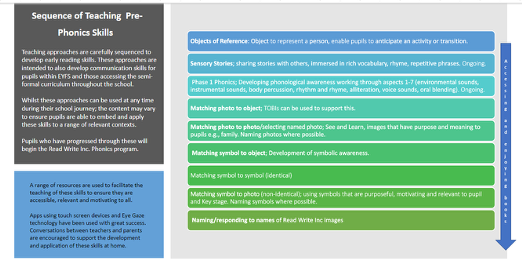
Pre-phonics skills form the foundation for early reading and communication development. It is important to recognise that these are not sequential and can be introduced at any stage, with a presumption of competence for all learners.
Key pre-phonics skills include:
Writing
At the Vale of Evesham School, we recognise the importance of writing in self-expression, and communication for both transactional and creative purposes. Students develop fine and gross motor skills across all strands of the curriculum in a variety of motivating activities. Students work to develop their transcription skills and composition skills in activities across the curriculum. The importance of oral composition is carried through Early Years across the school journey. Writing lessons are linked to text lessons to help learners build familiarity of language rhythms and patterns, through listening to spoken text and language. We recognise all students as writers and ensure that all writing is celebrated, this may be structured through use of symbols, marks, handwriting or computer aided.
Early Years Foundation Stage (EYFS):
Within Early Years building a familiarity of language patterns and rhythms is intrinsic in establishing the foundation of the skills for writing. The skills that are required for writing are built into everyday routines, linking with both reading and communication. To support the development of the language required for the building blocks of writing, the use of sign, symbols and objects of reference are incorporated into everyday routines. Songs are used to engage learners in recognising key vocabulary and language structures through interactive hearing and saying. Repetition is used to provide the vocabulary to discuss the learner’s daily world. Learners develop as story tellers through the use of small world play.
The development of both fine and gross motor skills to establish the necessary skills for writing are developed throughout a range of activities across the Early Years Curriculum. The development of fine motor skills is encouraged through the use of messy play and creative activities. Opportunities for exploration are encouraged with the sensory preferences of each student taken into consideration when planning activities.
Physical development sessions are delivered both in 1:1 teaching and whole class sessions. Where appropriate, key writing skills are targeted to individual pupils through work box activities. Some students following the Read Write Inc programme will develop their letter formation skills using writing implements. Please see the Early Years Long Term plan for further details.
Complex curriculum:
Please refer to our complex curriculum overview.
Semi-Formal Curriculum
Students working on the Semi-Formal curriculum continue to develop their skills as writers in line with their individual needs. They may work on individual writing packs, direct taught sessions, and a range of fine and gross motor skill activities to intentionally mark make. Fine and gross motor skills are developed through activities across the curriculum. Students work to develop to the skills that support pencil control skills through a motivating range of activities. These approaches include:
Jimbo fun, write dance, messy play, dough disco, multi-sensory approaches- tweezer and pom poms, tools etc.
The physical approach to learning is also utilised to help students develop their writing skills. TAGIV8 is used to develop spelling, punctuation and vocabulary for writing in subjects across the curriculum.
For pupils who can hold writing implements successfully, they will develop their letter formation skills and control using the Read Write Inc. Programme. This programme is used to inform planning and support progression. Read Write Inc. ‘Hold a sentence’ teaching approach is used to support the development of transcription skills. This can be delivered as whole class teaching, or a small group activity in line with their phonics skills.
In teaching the composition skills of writing the importance of oral repetition and rehearsal of language continues to remain a key focus. Students develop their oral composition skills through a variety of activities. The Talk for Writing approach is utilised to support the development of composition writing skills, with assessment tasks used to inform planning and delivery. Colourful semantics is used to help students develop their semantic understanding, relating writing to real life situations.
Signing is an imperative part of developing understanding of key vocabulary and is used to support comprehension and development of key concepts. Symbols continue to be used to sequence word order and support understanding. AACs are used to support writing as required by the individual pupil. Alongside specific writing lessons the skills of handwriting, sentence structure, punctuation and spelling are embedded in subjects across the curriculum.
In Strand 6 writing continues to be embedded in their Read Write Inc. Sessions and with their use of AAC to communicate.
Formal Curriculum
Formal learners focus on specific writing skills including spelling and grammar, handwriting and sentence structure. See appendix A for weekly allocations. Formal learners develop their writing skills for a range of purposes, developing awareness of audience. They work to recognise the specific features of different forms of writing, both formal and informal. Students have frequent opportunities to write creatively and for practical purposes. Students continue to use the ‘Hold a sentence’ approach to develop transcription skills where appropriate, developing their knowledge of spelling in line with RWI. phonic knowledge. This also offers a focus on use of punctuation. ‘Talk for Writing’ is used to support students to develop their writing for a desired purpose and increasing their knowledge of required features of text. Writing skills continue to be linked with text lessons, developing the student’s enjoyment in writing. Students are taught to write creatively and for practical purposes. Real word applications of writing are frequently explored in subjects across the curriculum.
In HS2 Formal students work towards an Entry Level Qualification in English. As part of this qualification students apply their writing skills for creative and transactional purposes. Writing assessments are tailored to motivate students and allow them to demonstrate their strengths.
Formal Learners in Strand 6 utilise their writing skills for real life purposes and work towards a NOCN Using Employability Skills Qualification. Where it is appropriate students will access GSCE English Language.
Impact
Progress in writing is monitored termly using Evidence for Learning. The data created by Evidence for learning is analysed within class teams to identify where specific interventions could be of benefit to individual pupils. Work scrutiny is continually used to evaluate practise within school, across all strands of the curriculum. Formal learners develop their writing skills following the appropriate formal accreditation route in Year 9 and above.
Appendix A
| Phonics and Reading (Weekly Timing) | ||
| Semi-formal | Formal | |
| FS1 | 45 mins- 4 times | |
| FS2 | 45 mins- 4 times | |
| FS3 | 45 mins- 4 times | 45 mins- 4 times |
| HS1 | 45 mins- 4 times | 45 mins- 4 times |
| HS2 | 45 mins- 4 times | Minimum of 30 mins- 3 times |
| Strand 6 | 3-4 guided teaching session and then embedded through functional project work. | |
| 10-15 minutes of whole class reading/ poetry should be done at the end of each day wherever possible, to promote a love of reading. | ||
| Writing and Fine Motor Skills (Weekly Timing) | ||
| Semi-formal | Formal | |
| FS1 | 60 mins (or 2×30 mins) | |
| FS2 | 60 mins (or 2×30 mins) | |
| FS3 | 60 mins (or 2×30 mins) | 60 mins (or 2×30 mins) |
| HS1 | 60 mins (or 2×30 mins) | 60 mins (or 2×30 mins) |
| HS2 | 60 mins (or 2×30 mins) | Some working towards Combined Entry level/ GCSE English (3 hours) |
| Strand 6 | Not explicitly taught in this age range, but skills applied through functional project work. | |
| Text and Literature (Weekly Timing) | ||
| Semi-formal | Formal | |
| FS1 | 60 mins (or 2×30 mins) | |
| FS2 | 60 mins (or 2×30 mins) | |
| FS3 | 60 mins (or 2×30 mins) | 60 mins (or 2×30 mins) |
| HS1 | 60 mins (or 2×30 mins) | 60 mins (or 2×30 mins) |
| HS2 | 60 mins (or 2×30 mins) | Some working towards Combined Entry level/ GCSE English (3 hours) |
| Strand 6 | N/A to this age range. | |
At Vale of Evesham, we recognise and advocate that communication is a fundamental human right. We place communication at the heart of everything we do and view every interaction as an opportunity to develop and enhance our pupils’ communication skills.
We adopt a Total Communication approach, as outlined in our Total Communication guidance document. Pupils are offered a wide range of opportunities to develop their communication skills through both planned activities and spontaneous interactions throughout the school day.
To support pupils in expressing their needs, feelings, and ideas, a multidisciplinary approach is often required. This draws upon the expertise of teaching staff, Speech and Language Therapists, MSI specialists, and Occupational Therapists. Staff are able to make referrals to Speech and Language Therapy at any point during the year.
Within the school, we have two qualified Signalong tutors who provide training for all staff. These tutors offer ongoing support, helping staff to learn and use new signs linked to key vocabulary across all curriculum areas each term. We use signs and symbols alongside speech, gesture, facial expression, eye contact, and body language to support understanding.
Signalong is designed to support spoken language, with signs and symbols used alongside speech to highlight key words and reinforce communication.
We aim for all our pupils to establish a system of expressive and receptive communication that is appropriate for them. In doing so, pupils will access learning and develop positive social relationships. Methods of communication take many forms at the Vale of Evesham School, including:
- Body language
- Facial expressions
- Eye contact
- Intensive Interaction
- Gestures and pointing
- TaSSels
- Signing (Signalong)
- Vocalisations
- Use of objects of reference
- Use of photographs
- Use of symbols/drawings
- Use of low and High-Tech AAC
- Speech
- Writing
- Staff are also in tune with learners Affective Communication.
Intent:
At the vale of Evesham school, we aim for our pupils to:
- Express consent or reject.
- Recognise familiar people
- Communicate a needs and choices
- Ask question to gain information and answer questions.
- Initiate polite and appropriate conversations
- Develop skills to prepare them for life after school
Implementation:
Alongside a Total Communication approach, all pupils at Vale of Evesham receive dedicated lessons focused on developing communication, speaking, and listening skills. This provision is highly personalised, with learning tailored to each pupil’s individual needs and curriculum pathway.
The Early Years and Complex pathways each have their own specific documents outlining how communication is embedded within their curriculum.
In addition, every pupil has an Individual Learning Intention for communication, which is reinforced and developed at every appropriate opportunity throughout the school day. Each child also has their own communication passport on Evidence for Learning, which details their expressive and receptive communication needs to ensure a consistent and informed approach across all staff.
Semi-Formal Curriculum
Communication in Semi-Formal works on Sticky Skills and Sticky knowledge. These are the set of core skills and knowledge that we want each semi-formal pupil to leave school with. These skills are broken down further within the Vale Communication Levels. This allows teachers to show entrance and exit points following each unit and over longer periods of time, it also shows clear progression in the skill or knowledge. The skills and knowledge are outlined as follows:
1. I can communicate my wants, my needs and for pleasure.
2.I can engage in and navigate a range of social interactions.
3.I can answer a range of questions.
4.I can ask a range of questions.
5.I can follow instructions.
6.I can attend appropriately to a range of situations.
7.I know a range of vocabulary.
8.I can use a range of vocabulary.
Semi-formal learners access one dedicated Communication lesson each week, which focuses on the Long-Term Plan. Individual SaLT (Speech and Language Therapy) targets and ILI (Individual Learning Intentions) are delivered through interventions, targeted teaching time, and within pupil-initiated learning.
In HS2, students have the opportunity to choose the Signalong for Learners course as part of their curriculum. This inclusive and interactive course introduces students to Signalong, a keyword signing system designed to support spoken communication.
Formal curriculum:
Pupils who access the formal curriculum receive one dedicated speaking and listening lesson each week. These sessions support the development of social skills while providing a wide range of communication opportunities, including participation in plays, engaging in debates, and collaborating in groups of varying sizes. Communication is further embedded across the curriculum, with a strong emphasis on extending vocabulary and developing pupils’ confidence, competence, and attentiveness in both speaking and listening.
When pupils move into High School they will access appropriate accreditation:
| Title | Award | Stage |
| Entry Level English (Pearson Edexcel) | Entry Level 3 | HS2 |
| English Language GCSE (Pearson Edexcel) | GCSE | |
| Signalong for Learners (This is optional) | Pre Entry Level- Entry Level 2 | HS2 |
Strand 6
Within Strand 6, students undertake one dedicated communication session per week, delivered in accordance with the Long-Term Plan (LTP). In addition, students continually work towards their Individual Learning Intentions (ILIs), as identified within their Education, Health and Care Plans (EHCPs). The development of communication skills is further systematically embedded across project-based learning, option subjects, and volunteering opportunities throughout the school.
Impact
Communication for Semi-Formal and Formal learners is assessed using the Vale Levels framework on Evidence for Learning, with assessment being continuous throughout the academic year. In addition, the TALC is used to assess pupils’ Blank Levels of Abstract Language. This assessment is completed annually during the summer term by teachers and is uploaded to Evidence for Learning.
Where appropriate, Speech and Language Therapy (SaLT) sets communication targets throughout the year. These targets are reviewed either upon completion or when adjustments are required. While this review cycle may not align exactly with Annual Review timings, progress and any changes are discussed as part of the Annual Review process.
To support continuity and sustained progress across the school, detailed transition processes take place during the summer term. Individual communication profiles for each learner are accessible via the Forms section on Evidence for Learning, ensuring that key information is consistently shared and used to support learners effectively.


