Sixth Form
The Special Educational Needs and Disability Code of Practice describe preparing for adulthood as preparing for:
- Education, Training and/or Employment- Courses learners might like to study and where, what type of work they might want to do, either paid or volunteering and about how to get a job.
- Participating in Society- Having friends and supportive relationships and being part of the local community, also things to do in your spare time and keeping safe.
- Being as Healthy as Possible in Adult Life- Who and what is there to help you stay healthy.
- Independent Living- Living as independently as you’re able, doesn’t mean living on your own.
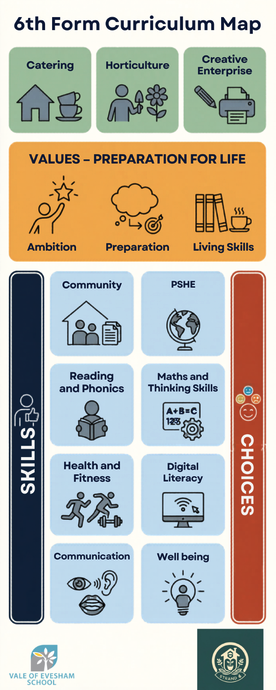
With this in mind, we have carefully developed a Strand 6 curriculum that addresses all areas of Preparation for Adulthood (PfA) and, most importantly, equips our learners with the skills and confidence they need for life and for whatever comes next at each stage of their journey.
Each learner in HS2 will have the opportunity to choose from Horticulture, Catering, or Creative Enterprise. These pathways reflect employment/ volunteering opportunities within the local area, align with student interests, and provide valuable opportunities to develop a wide range of transferable skills. These skills will support learners as they transition from the Vale of Evesham School into their next stages of education, training, or employment.
Horticulture
In Horticulture sessions, learners work as a team to learners maintain our horticulture space, learn about planting, propagation and cultivation for flowering plants, herbs and vegetables and make use of any surplus plants for cafe ingredients and enterprise stock. In addition, they will learn to use a range of tools and resources to enhance our spaces through the construction and upcycling of furniture and planters to place around the school and sell via our Enterprise endeavours.
Catering
In Catering sessions, learners are able to work towards gaining a Food Hygiene Qualification and develop a range of kitchen and finance skills through the running of a Staff Café/ Parent sessions (snack and chat), catering for school events and working alongside our School Cafeteria team, preparing meals and salad bar for the whole school.
Creative Enterprise
Students will engage with a variety of tools, basic machinery and equipment to design and produce products for sale. These products will be sold at school fayres and community events, as well as throughout the year in the Strand 6 shop, which is accessible to staff, parents and students.
Through these projects, students will take increasing responsibility and accountability for the full enterprise process, including:
- Planning and product design
- Budgeting and pricing
- Manufacturing and quality control
- Advertising and promotion
- Selling and customer interaction
Reading
All students engage with Reading working towards individual goals. Where appropriate Read Write Inc (RWI) Fresh Start scheme is utilised as an intervention to teach and build confidence in reading. For those working beyond RWI, Reading is further developed through VIPERS questioning, comprehension skills and the engagement with Work Related Texts.
All students are encouraged to share stories, read for pleasure and access local libraries.
PSHE
In Strand 6 Semi and Formal, PSHE is taught for 30 mins a week, following the Vale PSHE Long Term Plan. he Vale PSHE LTP provides a clear framework to support consistency and progression across the strand, while still allowing flexibility to meet the needs of individual learners. In addition to following the planned curriculum, sessions are responsive to pupils’ experiences and the wider community. Staff adapt learning to address any emerging issues or themes that arise from the local context, ensuring that PSHE remains relevant, meaningful and supportive of pupils’ personal development, safety and wellbeing.
This responsive approach enables staff to provide timely support and guidance, helping pupils to navigate real-life situations and develop essential life skills in a safe and supportive environment.
Health and Fitness / Mental Health and Wellbeing
As part of our curriculum, Strand 6 learners can engage with the Duke of Edinburgh Award- partaking in volunteering, physical activity, map reading, skills development and camping. This also includes local walks, community visits and making use of the local Leisure Centre for Gym or Swim sessions.
All learners are given the opportunity to make a choice in Mental Health and Wellbeing sessions to develop hobbies and interests (arts, drama, beauty, projects).
In addition, learners will have the opportunity to engage in the local community, building confidence in utilising local resources such as the library, volunteering at events, shops and public transport facilities. This includes the planning and running of Coffee Mornings, supporting sports festivals, school celebrations and fundraising events. Learners can also support the FS1-3 pupils through supporting lunchtime clubs such as dance, choir, music, football, multi-sports and developing play skills.
Living Skills
All students in Strand 6 follow a living skills programme provides students with valuable opportunities to develop and strengthen the practical abilities needed for independent living. Through structured activities and hands-on experiences, students learn essential kitchen skills such as preparing simple meals, understanding nutrition, and practising food safety. In addition, the programme focuses on home management skills, including cleaning routines, organising living spaces, managing time, and basic budgeting. By engaging in these real-life tasks, students build confidence, responsibility, and self-reliance, equipping them with the knowledge and habits needed to navigate everyday life successfully.
Community
Within Strand 6, students will regularly access the local and wider community to develop independence, confidence, and functional life skills. Learners will progressively build their understanding and use of public transport, accessing a range of local towns and community facilities, including shops, leisure venues, services, and public spaces.
Students will be supported to exercise increasing autonomy in choosing destinations and activities, within agreed overarching themes that promote safety, purposeful engagement, and progression. Students will plan and participate in day trips, developing key skills such as reading timetables, identifying suitable transport links, managing costings, and organising journeys.
Digital Literacy
Within Strand 6, students will participate in structured digital literacy lessons designed to develop the fundamental skills required to use technology safely, confidently, and purposefully across a range of contexts. Students will be taught a series of clearly defined digital literacy topics, which will then be applied meaningfully within their chosen vocational and enterprise options, including horticulture, café enterprise, and creative enterprise, as well as within community access and project organisation sessions.
Learners will develop an understanding of how digital tools such as mobile phones, emails, websites, and apps can be used effectively in everyday life, employment, and community settings. Teaching will draw upon and reinforce students’ reading, writing, and online communication skills, supporting their ability to access information, communicate appropriately, and complete digital tasks independently.
E‑safety will underpin all aspects of digital literacy learning, ensuring that students understand how to stay safe online, manage digital risks, and make informed choices when using technology.
Throughout their time in Strand 6, students will be supported to manage their own online record of learning and will access the Evidence for Learning learner app. This will enable students to upload evidence, reflect on progress, and develop independence, ownership, and digital responsibility in line with their Preparing for Adulthood outcomes.
Maths/Thinking Skills
In Sixth Form, Maths and Thinking Skills are developed through the Preparation for Adulthood (PFA) and Vale Independent Living Skills programmes, supporting students’ Personal Progression Plans (PPP). Learning focuses on applying skills in real-world contexts, with an emphasis on financial literacy, projects, and time management. Measuring skills are also reinforced in areas such as Horticulture and Catering.Through work experience, students learn to use everyday systems (e.g. tills, phones, email, and online tools) and are supported to manage a bank account and understand financial responsibilities as they approach adulthood.
Communication:
Within Strand 6, students undertake one dedicated communication session per week, delivered in accordance with the Long-Term Plan (LTP). In addition, students continually work towards their Individual Learning Intentions (ILIs), as identified within their Education, Health and Care Plans (EHCPs). The development of communication skills is further systematically embedded across project-based learning, option subjects, and volunteering opportunities throughout the school.